
Clarity for Complex Systems
Support for What Comes Next
Consulting, education, and practical resources for the organizations, professionals, and families navigating healthcare, education, and disability services.

DISABILITY-CENTERED. SYSTEMS-INFORMED.
HOW WE HELP
Different needs.
A connected approach.
AJL combines systems knowledge, professional expertise, and practical insight to help organizations, professionals, and families navigate challenges, strengthen services, and move forward with greater clarity.
Organizational Consulting
Understand operational gaps, strengthen referral and service infrastructure, and develop programs that support clearer, more coordinated service delivery.
Family & Systems Navigation
Non-clinical consultation to help individuals and families understand complex systems, evaluate options, and identify practical next steps. Organizations can also sponsor consultations through AJL's Family Navigation Partnerships.
Education & Training
Practical workshops and professional education on systems navigation, neurodivergence, caregiver experiences, and difficult conversations.
Educational Resource Development
Development of accessible educational materials, practical tools, and visual resources that make complex information easier to understand and use. Includes Little Choices™, AJL's educational resource brand.
AN AJL RESOURCE BRAND
Little Choices™
Visual supports for growing minds and confident choices
Low-stimulation visual supports for early learners, designed by a licensed social worker and parent of a neurodivergent child
From routines and transitions to communication and self-advocacy, Little Choices™ creates practical tools that support understanding, not control.
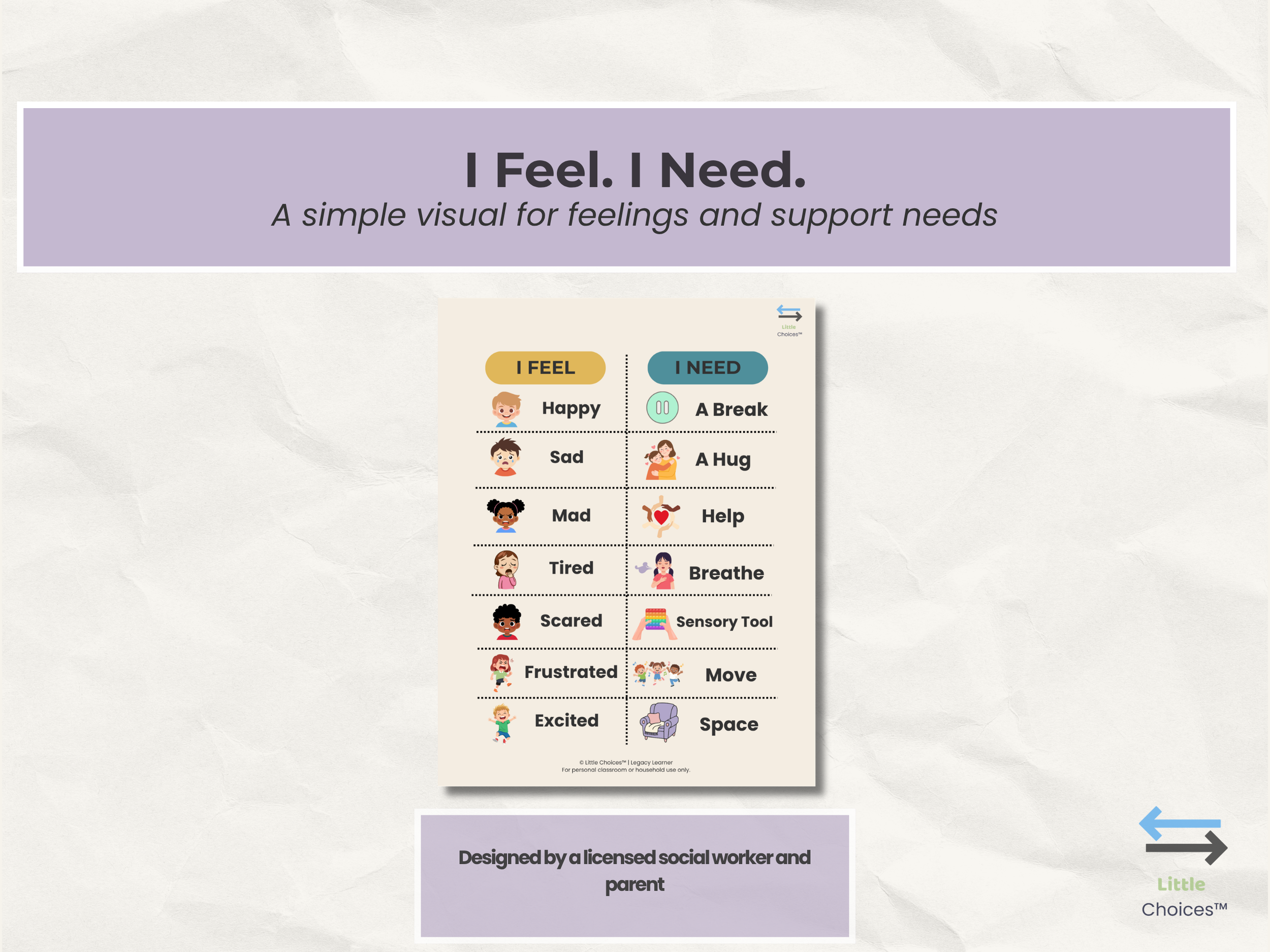
I Feel/ I Need Poster
Professional experience.
A parent’s perspective.

MEET THE FOUNDER
Adjani Jenkins-Lemar
MSS, LSW · FOUNDER & CEO
Adjani Jenkins-Lemar is a licensed social worker and founder of AJL Consulting Group. With years of experience across healthcare, behavioral health, and family support settings, she brings firsthand knowledge of how organizational processes, communication, and service coordination affect the people navigating them.
Her professional experience includes hospital-based social work, care coordination, patient advocacy, and program development. This background informs AJL’s approach to organizational consulting, professional education, and practical resource development.
As a parent navigating her child’s disability services, Adjani also understands the work that happens between appointments: interpreting information, asking questions, following up, and keeping providers connected.
She brings both perspectives to AJL’s work, combining professional expertise with practical insight to make complex systems more understandable and support more useful.
WORKING WITH AJL
A clear place to start
01 · Identify the need
Tell us what you’re navigating, what is getting in the way, and what you want to accomplish.
02 · Define the scope
Together, we establish the service, deliverables, timeline, and fee before work begins.
03 · Move forward
Receive focused consultation, education, or resources tied to the priorities we’ve agreed on.
AN AJL CONSULTING GROUP PUBLICATION
A Little Nuance
A closer look at disability, care, and the systems shaping everyday life.
Each month, A Little Nuance examines the questions, challenges, and overlooked details shaping disability services, healthcare, and everyday experiences. Written for professionals, organizations, families, and caregivers, it brings practical insight and perspective to conversations that deserve more than a simple answer.
 A Little Nuance An AJL Consulting Group Publication | ||
Issue 01 | Inaugural Edition | ||
The Main Perspective When Families Become the System CoordinatorsWritten by Adjani Jenkins-Lemar, MSS, LSW We talk about family-centered care, interdisciplinary collaboration, and coordinated services as though the language itself guarantees the practice. But what does coordination actually look like beyond organizational mission statements and professional expectations? A physician completes an evaluation. A therapist develops recommendations. An educator establishes a plan. Each professional may be competent, committed, and fulfilling the responsibilities of their role. Yet the family is still left relaying information, reconciling recommendations, tracking next steps, and identifying what falls through the cracks. The issue is not necessarily a lack of professional expertise or good intentions. It is whether the systems surrounding these professionals have established who is responsible for connecting their work. When coordination depends on families filling those gaps, we have to ask: are we providing coordinated care, or are families providing the coordination? Families are often described as essential partners in care, and they should be. They bring an understanding of their children that no professional evaluation or service plan can fully capture. But there is a difference between valuing family expertise and assuming families have unlimited capacity. Participation gradually becomes responsibility. Parents and caregivers are expected to understand unfamiliar terminology, communicate across disciplines, recognize gaps in services, and follow up when processes stall. These expectations often go unspoken, as though having a vested interest in a child’s well-being automatically comes with the time, resources, and knowledge required to navigate complex systems. It doesn’t. And when organizations rely on that assumption, the ability to maintain continuity can depend less on how services are designed and more on what individual families can manage. The consequences become clearer when we consider that not every family has the same resources to navigate these systems. A parent with a flexible work schedule, professional knowledge, or a strong support network may have an easier time identifying problems and getting answers. Another parent may be just as involved and committed but have fewer resources to draw on. Yet on paper, both families may appear to be receiving the same level of support. Appointments are completed, paperwork is submitted, and services are provided. What those records don’t always show is the work families must do to keep everything connected. When a system depends on families to fill its gaps, we risk measuring success by the services delivered rather than how well those services actually work together. We also risk mistaking a family’s limited time or resources for a lack of involvement. Perhaps it is time to reconsider what we mean by family-centered care. Families should have a meaningful voice in decisions, access to information, and the ability to shape the services they receive. But being a partner should not mean being responsible for holding an entire system together. Organizations may not be able to eliminate every barrier, and professionals cannot reasonably be expected to operate beyond their roles. Still, there is room for greater accountability in how information is shared, how concerns are addressed, and who takes responsibility when something falls between services. Family-centered care should be reflected not only in how organizations involve families, but in how effectively they support them. Families deserve to be partners in their care, not the infrastructure holding it together. | ||
| ||
On Our Radar
| ||
| ||
| ||
A Little Nuance | An AJL Consulting Group Publication |
START A CONVERSATION
What would you like
to move forward?
Tell us what you’re working through, developing, or planning. We’ll review your inquiry to determine whether AJL’s services are a fit and identify an appropriate next step.
Initial Inquiry Guidance
Please provide a brief, general overview of your needs. Do not include medical records, diagnoses, or other sensitive personal information in your initial inquiry.